Type a date, a time of day or a length of time the way you would say it, and Babbage does the calendar arithmetic: days between two dates, a date plus three weeks, the weekday of Easter, nine o'clock in London as seen from Tokyo.
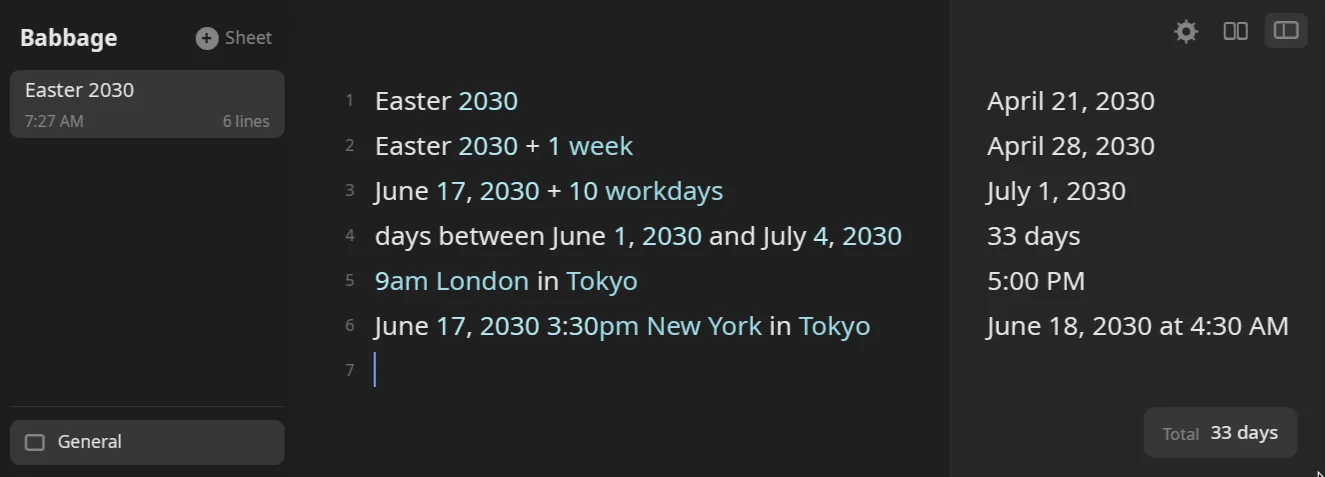
Dates and times follow your machine's clock and time zone. The examples in this chapter use explicit dates so they come out the same whenever you read them. Where a date is in the current year the answer leaves the year off (June 17), and in any other year it shows it (June 17, 2030).
Writing a date
All of these are the same day:
| You type | Notes |
|---|---|
June 17, 2030 |
The usual form. |
Jun 17 2030 |
Three-letter month, comma optional. |
June 17th, 2030 |
st, nd, rd, th are accepted. |
17 June 2030 |
Day first. |
2030-06-17 |
Year, month, day. |
6/17/2030 |
Month first by default. |
A date with a slash is read month first (12/02/1988 is December 2). Turn on "Day first in 12/02/1988" in Settings, Dates & Times and it is read as 12 February. See Settings.
A date with no year (June 17) is this year's. Words work as dates too:
| Word | Means |
|---|---|
today, tomorrow, yesterday |
Relative to the clock. |
Monday |
The next Monday after today. |
next Friday, last Friday, this Friday |
That weekday, forwards, backwards, or the coming one. |
Tuesday next week |
Also last week and this week; weeks start on Sunday. |
now |
The time of day, to the minute. |
A date followed by a time makes one moment: June 17, 2030 at 3:30pm and June 17, 2030 3:30pm both answer June 17, 2030 at 3:30 PM. Answers that fall on the day before or after today read Yesterday at or Tomorrow at.
Holidays
Name a holiday and Babbage finds the day. Add a year for a particular one, or leave it off for the nearest this year.
| You type | Answer |
|---|---|
Easter 2030 |
April 21, 2030 |
Good Friday 2030 |
April 19, 2030 |
Easter Monday 2030 |
April 22, 2030 |
Orthodox Easter 2030 |
April 28, 2030 |
Christmas 2030 |
December 25, 2030 |
Boxing Day 2030 |
December 26, 2030 |
Thanksgiving 2030 |
November 28, 2030 |
Black Friday 2030 |
November 29, 2030 |
Halloween 2030 |
October 31, 2030 |
Valentine's Day 2030 |
February 14, 2030 |
New Year's Eve 2030 |
December 31, 2030 |
Chinese New Year 2030 |
February 3, 2030 |
Ramadan 2030 |
January 5, 2030 |
Hanukkah 2030 |
December 20, 2030 |
Also understood: Christmas Eve, New Year's Day, Holy Saturday, Easter Sunday, Orthodox Christmas, Orthodox Good Friday, End of Ramadan, End of Hanukkah and Chinese New Year's Eve. A holiday is an ordinary date, so you can add to it (Easter 2030 + 1 week is April 28, 2030) or ask its weekday (weekday of Easter 2030 is Sunday).
Date plus or minus a span
Add or subtract days, weeks, months or years:
June 17, 2030 + 30 days
June 17, 2030 - 2 weeks
June 17, 2030 + 1 year 2 months
2 weeks from June 17, 2030
10 days after January 1, 2030
2 days before Christmas 2030
The first gives July 17, 2030, and the next June 3, 2030, August 17, 2031, July 1, 2030, January 11, 2030 and December 23, 2030.
Days, weeks and seconds are exact. Months and years follow the calendar and the day clamps at the end of a month: Jan 31, 2030 + 1 month is February 28, 2030. Several spans in a row apply in turn (2 months 3 days after June 5, 2030).
Going back in time works with ago: 5 days ago and 3 months ago give a date and time.
The span between dates
Subtract two dates, or join them with to, to get the gap as weeks and days:
June 17, 2030 - June 1, 2030
June 1, 2030 to June 17, 2030
Both give 2 weeks 2 days. Reverse them with - and the answer is negative: June 1, 2030 - June 17, 2030 is -2 weeks 2 days. Ask for one unit by adding in days:
| You type | Answer |
|---|---|
January 1, 2030 to December 31, 2030 |
11 months 4 weeks 2 days |
January 1, 2030 to December 31, 2030 in days |
364 days |
days between June 1, 2030 and July 4, 2030 |
33 days |
April 1, 2030 through April 30, 2030 |
30 days (both ends counted) |
time until December 25, 2030 |
The calendar gap from now. |
time since January 1, 2030 |
The calendar gap since then. |
Two dates with no year, written alone on a line, subtract to the span forward from the first. Dates are also counted from the clock: days until Christmas, days since January 1, days until June 15, 2030 and days left in 2030 count from today.
Parts of a date
| You type | Answer |
|---|---|
day of the week on March 12, 2023 |
Sunday |
what day is June 17, 2030 |
Monday |
week number of June 17, 2024 |
25 |
day number on June 17, 2024 |
169 (the day of the year) |
days in February 2024 |
29 days |
days in Q3 2024 |
92 days |
days in 2024 |
366 days |
year percentage |
How much of this year has gone. Also month, week and day. |
Workdays
A workday is Monday to Friday. A span of workdays counts the first day and not the last.
| You type | Answer |
|---|---|
June 17, 2030 + 10 workdays |
July 1, 2030 |
workdays between June 1, 2024 and July 4, 2024 |
23 workdays |
work days from June 3, 2024 to June 28, 2024 |
19 workdays |
workdays in June 2024 |
20 workdays |
workdays in 3 weeks |
15 workdays |
workdays until Christmas |
Workdays from today. |
work hours between June 3, 2024 and June 7, 2024 |
32 hours |
55 hours in workdays |
6.875 workdays |
Once a workday is in the line, a week counts as five workdays. Work hours multiply workdays by the length of your working day, 8 hours unless you change "Hours in a working day" in Settings, Dates & Times.
Public holidays are not guessed. List the days you do not work in Settings, Dates & Times, under "Public holidays": 2026-12-25 for a single date, 12-25 for the same day every year, separated with ;. Workday arithmetic then skips them.
Times of day
| You type | Answer |
|---|---|
3:30 pm |
3:30 PM |
15:45 |
3:45 PM |
noon, midnight |
12:00 PM, 12:00 AM |
9:15am + 45 min |
10:00 AM |
10pm - 3 hours |
7:00 PM |
noon + 14 hours |
Tomorrow at 2:00 AM |
7:30am to 8:45pm |
13 hours 15 min |
10pm to 6am |
8 hours |
5pm - 9am |
8 hours |
A time of day on its own never shows seconds, so 3:45:30 pm reads 3:45 PM. A date with a time does: December 10, 2030 at 9:31:23 AM. A gap between two times that crosses midnight rolls over, as 10pm to 6am shows.
Lengths of time
Write a length as parts or as one number with a unit:
3 hours 20 minutes
7 hours 45 min + 2 hours 30 min
90 minutes in hours
2 days 3 hours in hours
8 hours / 3
These answer 3 hours 20 min, 10 hours 15 min, 1.5 hours, 51 hours and 2.6666666667 hours. Add as timespan to spell a decimal out in parts (1.5 hours as timespan is 1 hour 30 min) and in minutes or any other unit to convert.
Three colons write a lap time, hours first: 00:01:30 is a minute and a half, and two lap times add (03:04:05 + 00:00:55 is 03:05:00). Speed changes a length: 1 hour 30 minutes at 1.5x is 1 hour, and time saved 5 min at 1.5x is 1 min 40 s.
Time zones
Say a time, the place it is in, and where you want it:
9am London in Tokyo
6pm Sydney in Chicago
8:00 Los Angeles to London
9am in London
The first answers 5:00 PM. Using to instead of in is the same. Leave the first place off and the time is read in your own zone. Add a date and the date comes along: June 17, 2030 3:30pm New York in Tokyo is June 18, 2030 at 4:30 AM.
Other forms:
| You type | Gives |
|---|---|
time in Tokyo or Tokyo time |
The time there now. |
date in Paris |
The date there now. |
time in Tokyo when it is 9am in London |
5:00 PM |
time difference between Sydney and Chicago |
How far the second place's clock is ahead of the first: -15 hours. |
now in Tokyo |
The current time there. |
Places Babbage knows:
- Cities (
Tokyo,New York,Los Angeles). - Countries (
Japan,Germany), meaning the capital's zone. - Regions:
Eastern time,Central time,Mountain time,Pacific time,Alaska time,Hawaii time,Atlantic time. - Airport codes such as
LAX. - Abbreviations. The US ones (
EST,PST,CSTand the daylight forms) mean the whole region with its summer time, so8am PST in Berlinfollows the season. Others are fixed offsets:CET,JST,IST(India),AESTand so on. - An offset:
GMT+8,UTC-5:30. - Your own names, from Settings, Calculator, "Your own names for places":
HQ = Europe/Berlin; Lab = Asia/Tokyo.
An answer in UTC or GMT shows on the 24-hour clock (3pm EST to GMT is 19:00 in summer). A zone-aware time is a whole-line operation: you cannot add to it or compare it afterwards.
Formats
End a date with as and a pattern to choose how it prints:
| You type | Answer |
|---|---|
June 17, 2030 as EEEE, MMM d, yyyy |
Monday, Jun 17, 2030 |
June 17, 2030 as dd/MM/yyyy |
17/06/2030 |
June 17, 2030 3:30pm as yyyy-MM-dd HH:mm |
2030-06-17 15:30 |
June 17, 2030 3:30pm as h:mm a |
3:30 PM |
June 17, 2030 as EEE |
Mon |
June 17, 2030 as iso8601 |
2030-06-17T00:00:00Z |
Timestamps and timecodes
| You type | Answer |
|---|---|
1718600000 to date |
June 17, 2024 at 4:53:20 AM UTC |
1718600000000 to date |
The same (a number of 100,000,000,000 or more is read as milliseconds). |
June 17, 2024 to timestamp |
1718625600 (a date alone is taken at noon). |
current timestamp |
Seconds since 1970 now. |
90 seconds as timecode |
00:01:30:00 |
1500 frames to timecode |
00:01:02:12 (24 frames a second) |
1500 frames to timecode at 30 fps |
00:00:50:00 |
1 hour in frames at 24 fps |
86,400 frames |
A timecode has three colons: hours, minutes, seconds and frames.